

Why I'm Not Going Paid on Substack
Why I'm Not Going Paid on Substack
Going paid on Substack may not be all it's cracked up to be

When I started this Substack nearly two years ago, soon after retiring from a competitive corporate life, my only thought was to indulge my love of writing. Freed from the confines of writing in the company’s interests, of aligning my thoughts with corporate goals and choosing my words with an eye to SEO (search engine optimization) and branding, I could find my own voice, explore topics and modes of thinking I’d rarely allowed myself time to pursue. My sole purpose was to take what I’d done professionally all my life, and explore it as a means of self-expression. I didn’t know how it would turn out—hell, I still don’t!—but I knew I wanted to dive deep. The result is my Substack, which offers me the opportunity to work on my “craft” and the unexpected pleasure of engaging with a collaborative and intelligent community of readers and writers.
But I hadn’t been working on my Substack long when I recognized a familiar sound—the siren song of capitalism—echoing around the edges of my experience. At first, it was just the quantitative clatter that Substack uses to inform me how I’m doing: the counting of views, likes, shares, subscribers. I learned to largely ignore those, as gratifying as they are, because what I really liked was the act of writing and the communication with writers and readers, and those weren’t really quantifiable.
But the counting that matters is the counting of dollars, for what ultimately drives Substack is getting writers to turn on paid subscriptions. Thus the Substack team devotes a lot of energy to promoting “going paid,” and the subject is endlessly discussed by writers. There’s so much talk about “going paid” that you sometimes feel that it should be every writer’s goal.
But should it be mine?
To find my answer, I’ve posed myself two questions, one simple, one exceedingly tricky:
Would I make any money if I went paid?
What would it do to me to go paid?
I’d Make No Money
The answer to my first question is very simple: no. Or at least, very little money until I got a very large number of subscribers.
Substack champions the opportunity for writers to earn money from their writing, and any writer can turn on paid subscriptions. But that doesn’t mean that it makes sense for everybody to go paid. I’ve concluded that the only people who should go paid are those willing to actively pursue the kind of subscriber growth that will make the compromises of going paid worthwhile.
Let’s start by considering the money involved should I reach a subscriber count that is still aspirational: 1,000 subscribers. (For what it’s worth, I’m sitting at 529 as I write this.)
Why 1,000? In part because it’s such a well-known target, thanks to Kevin Kelly’s famous essay, “1,000 True Fans,” in which he spelled out how someone could earn $100,000 a year by getting 1,000 “true fans” to pay $100 a year. $100,000 is legitimate money; it’s the kind of money that would allow a writer to live on their writing alone. But don’t think getting there is easy!

In the calculator on their page titled “Great Writing Is Valuable,” Substack encourages optimism about how easy it might be to reach such a figure. Their calculator shows what you earn from each paying subscriber. Thus if I billed my 1,000 true fans $60 per year (that’s $5 per month), I would net $4055 per month, or $48,660 a year (if you’re doing the math, the writer gets 81 cents on the dollar, after paying Substack and the credit card fees). Not bad! If I used their calculator, I might have lept right into going paid. After all, I only needed 2,000 true fans to hit Kelly’s $100,000 target.
Here’s the rub: on Substack, subscribers aren't really “true fans” until they express a willingness to pay. Your “true fans” are only a fraction of your total subscriber count. What fraction? Well, Substack advises: “We tend to see 5-10% of free subscribers convert to paying subscriptions, with 10% being a rate to aim for.” (Not a rate to expect, but to aim for.)
Because I’ve heard from writers that they don’t even reach that lower estimate, I wanted to take a more conservative view. So I built a calculator that counts how many total subscribers I’d need to find 5% willing to pay me $60 a year and lift me to Kelly’s $100,000 target. (You can make a copy of the calculator and play all you want.)
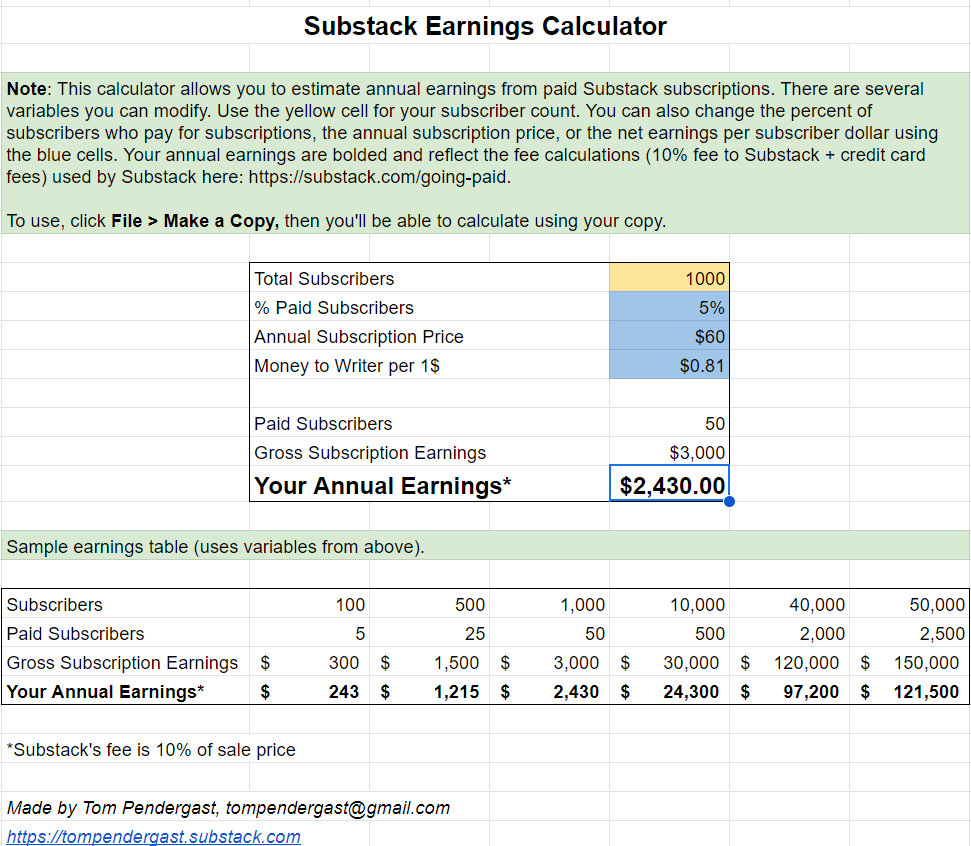
So, how many subscribers will I need?
41,153 subscribers!
Now that’s a pretty big number! That’s 78 times as many subscribers as I have today. No wonder people toss around the 1,000 true fans number. 1,000 isn’t scary; 1,000 feels attainable. But if all I have is 1,000 total subscribers, that translates to 50 “true fans” (i.e. paid subscribers) paying $60 a year and bringing me an annual income of $2,430.
Now I get that we all value money differently, and if that’s a meaningful number for you, then maybe you should still consider going paid. But what this makes clear to me is that turning on paid subscriptions isn’t going to be very meaningful, at least not until I grow my subscriber count substantially. So what else is in it for me?
Going Paid Would Turn Me Into an Asshole
Substack’s bold-face claim to be “the home for great writers and readers” and “a word-class reading and listening experience” is totally legitimate. The platform abounds with fascinating and thought-provoking writing. When I focus on the quality of my writing and the quality of my engagement with other writers and readers, I enjoy Substack quite a bit.
But what would happen if I devoted less attention to writing and engagement, and more to going paid and growing my subscriber count? Let me paint a scenario of how I think it would play out for me; your experience may be different.
First, I’ll have to craft a pitch to my readers to persuade them to pay me. I’ll have to explain why I’m worth paying for, justifying the value I bring to their life and suggesting that I’m really not asking for too much. This very act will force me to take this thing I’ve been doing out of joy, writing, and examine it in the cold light of economic valuation, in a web of comparisons and value calculations that begin to undermine the pleasure I take in my Substack.
I won’t want to come off as self-conscious and apologetic, but I won’t be able to suppress that entirely, and thus my sales pitch will feel tortured, at least to me. It’s not about the money, I’ll say. It’s about valuing my time and my effort, I’ll say. Even so, I’ll keep my price as low as possible, wary of scaring anyone away by asking for $8 a month instead of $5.
That first awkward pitch may snag a few paying subscribers, perhaps my Mom, maybe one (but not both) of my kids. Maybe I’ll win the hard-earned bucks of a couple of my fellow writers, the simpatico ones who share with me an understanding of the complicated pleasures of the writing life and want to encourage me. I’ll love that ... but a few subscribers isn’t likely to be enough. I’ll want more.
I’ll want more in part because “wanting more” is intrinsic to the act of going paid; it’s intrinsic to capitalism. But it’s also intrinsic to me, or at least to part of me ... the part of me I thought I’d left behind when I retired.
Once I embrace the goal of earning money, I know what will come next: I’ll want to earn more money. I know this about myself: I like to win! I want to be better than others. And that brings out a monster in me that I don’t always like. It brings out the guy who doesn’t want to play Scrabble with my wife because she always beats me. It brings out the guy who, 20 years ago, got too serious during a egg-and-spoon race at a family fun day, where my will to win was transparent and—as my friend Konrad likes to kid me—a little unseemly. I fear that going paid and pursuing growth will bring out the ugly side of me.
At the very least, going paid will force me to devote too much of my attention and mental space to the sales and marketing function, and too little to the creative work I so enjoy. (Hmm, this sounds an awful lot like my work life!) Going paid will cause me to look at other writers who are succeeding with paid strategies and compare myself to them. I won’t want to beat them so much as imitate them, figure out how to do what they do. I’ll monitor those who seem to be growing fast and I’ll incorporate their successes into my own Substack. I’ll remind my readers that they can “go paid” at any time, and I’ll craft ever more amusing and I hope enticing reasons for them to do so. Perhaps I’ll offer discounts and sales. Because once you’ve put something up for sale, it’s only natural to try to sell more.
Having committed myself to growth, I’ll go all in, even if I sometimes find it a bit demeaning, a bit embarrassing, and certainly a distraction from my writing. I’ll declare some of my writing to be of “higher value” (as if I get to decide that!), and I’ll put that high-value stuff behind the paywall. Of course I’ll have to justify that, constantly reminding my free subscribers that there’s more, more, more ... but only if they’re willing to pay.
But why stop there? What if I develop a scheme for “adding more value”? Maybe I host live calls or paid-subscriber-only chats. Maybe I’ll make videos or voice recordings of my writing or start hosting “chats” for paid subscribers only.... I’ll judge every change I make by these new standards I’ve embraced, growth and payment, and not by the standards I once held. If I conclude, egotistically, that giving more of myself leads to growth, would I know where to stop? What would I not be willing to do?
I’m exaggerating ... but only a little; if you want to see growth strategies on steroids, go check out the Substack of “influencer”
. She is fully committed. Who says that Substack is OnlyFans for ugly people?I may not go as far as Eva—really now, how could I?—but surely I can get better at deploying all the recommended growth strategies: I can hustle for likes, shares, restacks, and all those other little measures that get clicks and promise to bring me incrementally closer to the nirvana of more payments.
There’s more I can do: I can follow the advice to publish on a regular schedule—weekly is considered the standard. I’ve tried that, and I know that means that sometimes it makes my writing feel forced, but hey, if I keep putting chum in the water, something is bound to land with readers.
I’ll get better with my headlines too: I need those titles to catch people’s eyes. So I’ll try to juice them up a bit. How about “6 Surefire Ways to Alienate Readers”? People like lists! But it’s not just titles—I’ll also have to master the dark arts of SEO.
Soon enough, I’ll be spending more of my time trying to market and sell my writing than I am actually writing. And I know from my work life that focusing on salesmanship, social media posturing, and status seeking will start to make me lose sight of why I started writing this Substack in the first place. I’ll turn into the asshole that I never wanted to be.
Going Paid Is Not My Path
Must going paid turn a writer into a growth-obsessed asshole? Not at all.
has grown a huge paid subscriber base and remained a pillar of kindness and sincerity. One of my favorite writers, , went paid and promptly reduced the frequency of his posts so that he could concentrate on producing quality. He has exhibited none of the distorted behaviors I describe. has a paid subscription option but he never acts like a huckster. There are many others who have not allowed going paid to undermine the ethos of their publication. Still others turn on paid subscriptions simply as a means for people who want to pay them to pay them, without changing what they offer for free or how they communicate with subscribers. I get the patronage model and I might go that way ... but not now.For now, I don’t want to take the chance that going paid would interfere with or undermine what I’m doing. I’m still developing a voice and finding forms that suit me. I like spending as much time on my writing as I think it requires to get it right, even while my definition of “right” is always evolving. I’m incredibly flattered when people share or like my work, but I don’t want to ask them to do that, enlist them in my growth cause—that cheapens it for me. I’m genuinely gratified when people comment and I really enjoy the exchanges that happen in the comments section and the email exchanges I have with readers. All of that good stuff has nothing to do with getting paid. In fact, going paid might well threaten all that I enjoy about writing on Substack.
I’m digging what I’m doing and I’m going to keep doing it for free.
Notes and Caveats
This was a complicated piece to write. I entertained and discarded any number of potential arguments, many of which have been discussed extensively on Substack. I’m incredibly sympathetic to the challenges of doing creative work in a culture where the arts are often devalued economically, and I intend no criticism of anyone who has gone paid (though I own the implied criticism of some of the growth strategies people choose).
I do appreciate that if everyone chose not to go paid, Substack would not survive. I’m hopeful that enough people will succeed with going paid that Substack will survive and people like me can still do their thing. (If Substack required that writers who didn’t go paid themselves pay an annual fee, or supported the platform by having a minimum number of paid subscriptions, I’d likely find that acceptable.)
And look, I do know that I’m fortunate not to need the money generated by paid subscriptions. Needing money changes the dynamic. But I’d also argue that if you need money, there are better ways to get it than a Substack newsletter.
The following articles were top of mind as I wrote this piece:
- “How to Succeed on Substack.”
Kevin Kelly, “1,000 True Fans.”
Thanks for reading, and if you’d like to support my writing, please buy me a beer or drop me a note. For now, that’s quite enough.
👏👏👏👏👏👏👏👏👏👏👏👏👏👏👏👏👏👏👏👏👏👏👏👏(Tom, now imagine what a few million more of these would sound like, i.e., Taylor Swift concert encore response? That’s how I feel about this post. Bravo!)
I agree, Tom. Providing new ways of funding literary work is important, but there are incentives for Substack to push people toward a growth oriented perspective which is not aligned with deep work in writing. I've had to get creative to block them from showing me statistics etc so that I don't get nervous about things like that when I write. And for your calculator: I convert 3 percent which is pretty typical if you write intellectual essays, so I'm not about to get rich any time soon - but it makes a big differ on the margin when you have kids. Also, the people for whom the work is so valuable that they want to support it - that filters for very interesting people. So I feel happy about it, though it took a few months to figure out how to navigate the emotional pressures.