
#5: McClellan Butte
Thoughts about Fear and Vanity on an early season summit

It’s still early season for summits, at least if you want to do ‘em without ice axe and extensive snow travel. But it’s a weird early season: there’s just so little snow. So we’ve been banging out some of the peaks on the western edge of the Cascades along the I-90 corridor: Bandera, Mount Washington, and now McClellan Butte.
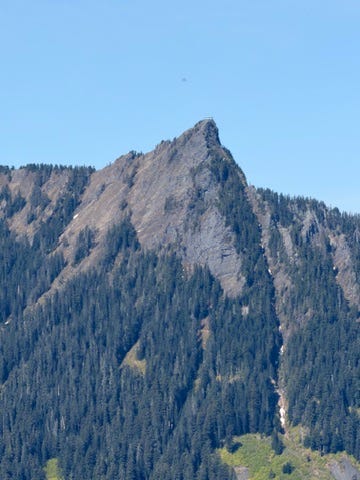
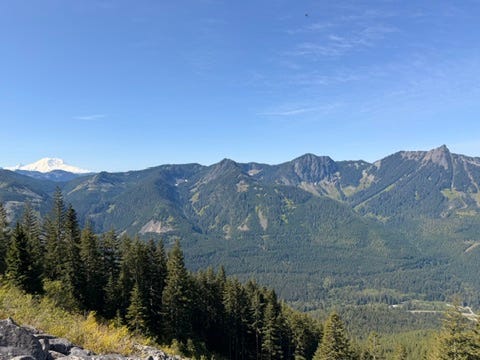
McClellan Butte is a striking rocky summit on the south side of the long valley that leads from the lowlands east to Snoqualmie Pass, and I’ve long been both drawn to it and a little scared of it. Drawn because it’s pointy but scared thanks to a story my buddy John tells about a friend of his who died on the mountain years ago, slipping to his death on the final steep rock scramble that ends the otherwise uneventful hike. I’ve been right to the edge of that scramble before with my buddy Scott, but it was gray and misty and we took one look at that last rocky section and decided that this was no day to attempt it.
Today, I hiked up with Sara and my daughter Louisa on a lovely dry day in May. At the shoulder before the summit we ran into half a dozen high-school boys, dicking around with their shirts off, their bodies all underdeveloped and pale. Young kids always look like colts to me: they just haven’t filled out yet. They were jockeying with each other, seeing who had the nerve to go up to the summit. I hadn’t told the girls about the guy dying up here. I didn’t figure it would help.
Louisa led the way and she coached Sara perfectly. “You always want to have three points down Mom,” she explained. “Two feet and one hand, or two hands and one foot. Lean yourself into the mountain. If you feel shaky, just get closer to the mountain, flatten yourself out.” She was calm and gentle.
Louisa advanced. The rock was bone dry and really stable—nothing loose or slippery. But it was steep as hell. If you somehow lost your balance and toppled downward, it wouldn’t take much for you to bounce down the rock and plunge off the cliff below. Louisa knew the risks, but she kept her mom focused with her constant positive banter.
“Watch where I plant my feet Mom and just match my hand and foot holds.” I heard echoes of the stuff I used to say to her when she was getting accustomed to scrambling, to being on rock and to steeling yourself to “exposure,” that strange little word mountaineers use to mean you’re in a position where, if you fell, you could die.
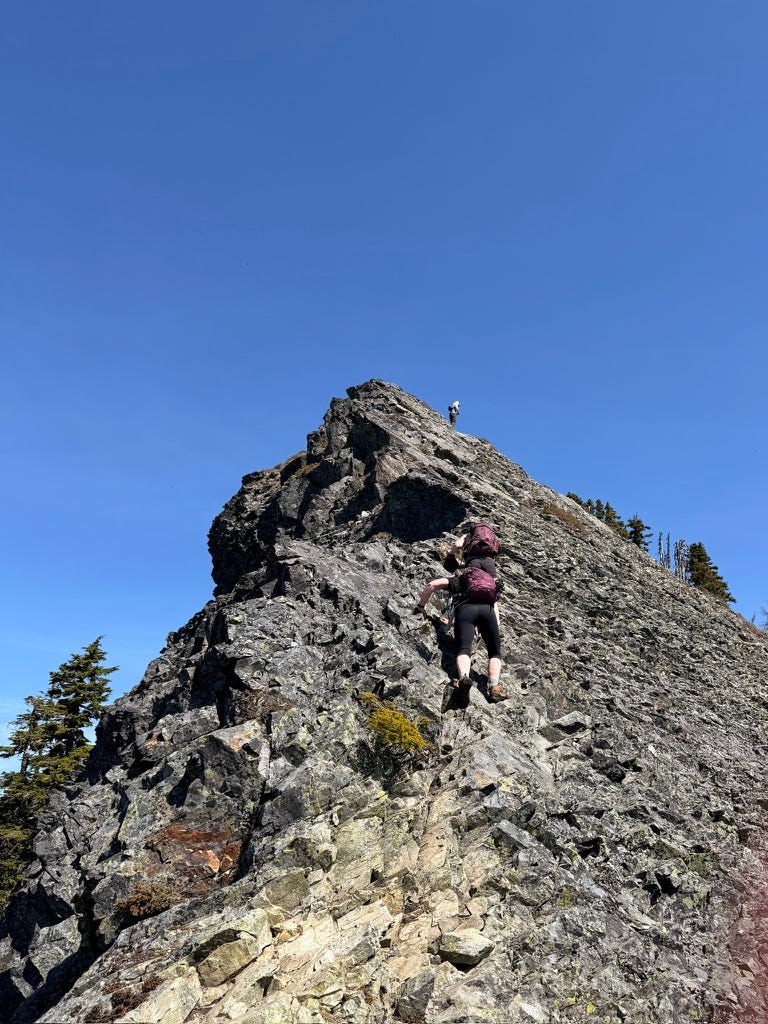
But you can’t think about falling. As Sara would say later, you can’t look at that gulf you could fall into. You just have to look at the solid rock in front of you and plant your hands and feet, testing the solidity of your hold, and then push onward to a place where you can relax again.
I was so proud of Louisa’s coaching, and so impressed with Sara’s courage, that I gave no thoughts to my own fear. Is it even fear, at this point? Now that I’ve done enough that I don’t really doubt my ability, now that I’m comfortable enough to take a long look at the chasm to my right and not clench up inside? If it’s still fear, it’s fear that I’ve come to terms with, made friends with. It’s not a fear that pounds in my ears, like I remember from my early days as a scrambler. Now it’s a quiet fear that brings focus.
I get reminders, from time to time, that fear is merited. Last week a solo hiker fell or slid to his death on Mt. Pugh, a mountain I’ve summited once and turned back on twice. We don’t know yet precisely where or how he fell; we never will know, most likely. But my gut tells me it’s on the same snow-field where I once felt the horror of falling most strongly, a horror that focused me on kicking my crampons deep into the snow, holding fast to my ice ax, preparing for the snow to slip and for me to slam myself into arrest.
You can die on any mountain. You can die as a novice or as an experienced mountaineer. I just try to prepare myself mentally and physically for the challenge, and to remind myself that the best mountain is the one you come home from. I hope never to be so proud or obdurate that I won’t turn around if something doesn’t feel right. But I also want to do the hard stuff, the stuff that requires me to push past my fear and get to the summit. And I want to do it with my darling wife. Her climb up McClellan was a step in the right direction.
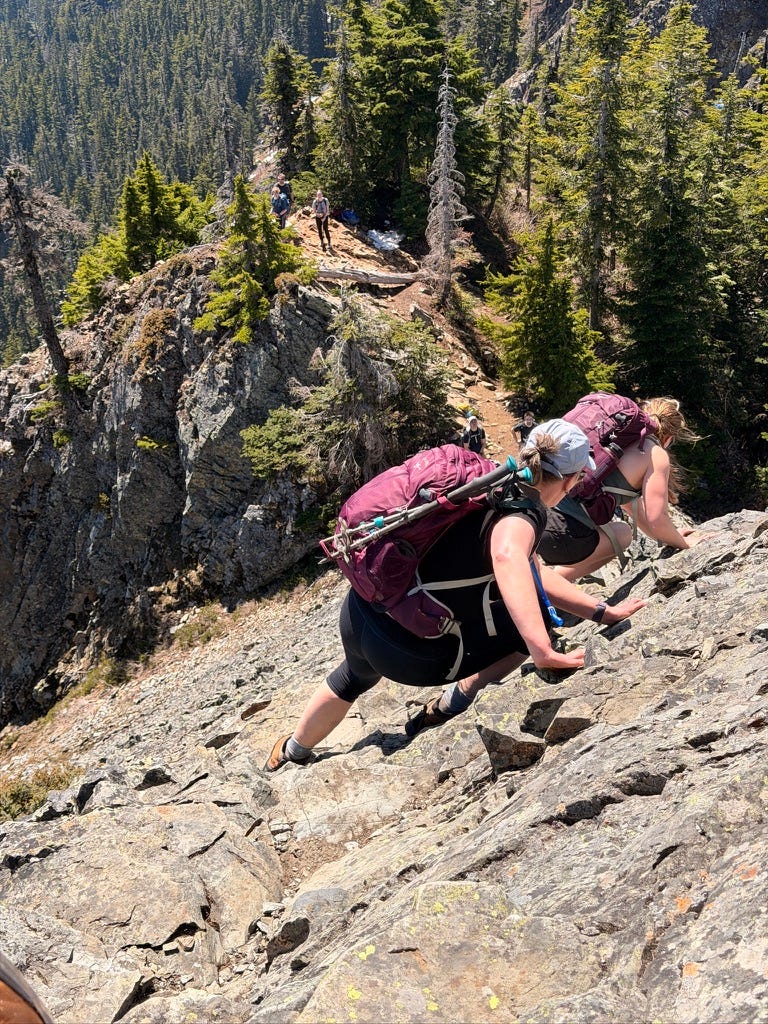
About two thirds of the way coming down from the summit block, I called out to the girls: “Did I tell you the story about John’s friend and this mountain?”
“You can tell us when we’re down!,” replied Sara. So I told them when we were down. They were glad I held back.
Vanity
Fear is a complicated emotion, but then so is another one I’m struggling to come to terms with: Vanity. My own.
I’ve been working out at the gym steadily for two years now. According to my InBody scan (this is a body composition analysis tool they have at the gym), I’ve lost almost 40 pounds while adding 9 pounds of lean muscle mass. My percent body fat has dropped from 30.7% to 14.3%. I’ve gone from a solid Dad Bod to ... I’m not sure what to call what I am now. But I know I permit myself to wear tank tops again, something I didn’t do for years.
So when I saw all those scrawny boys preening around near the summit with their shirts off, I popped off my shirt too. I’ll show them what muscles look like.
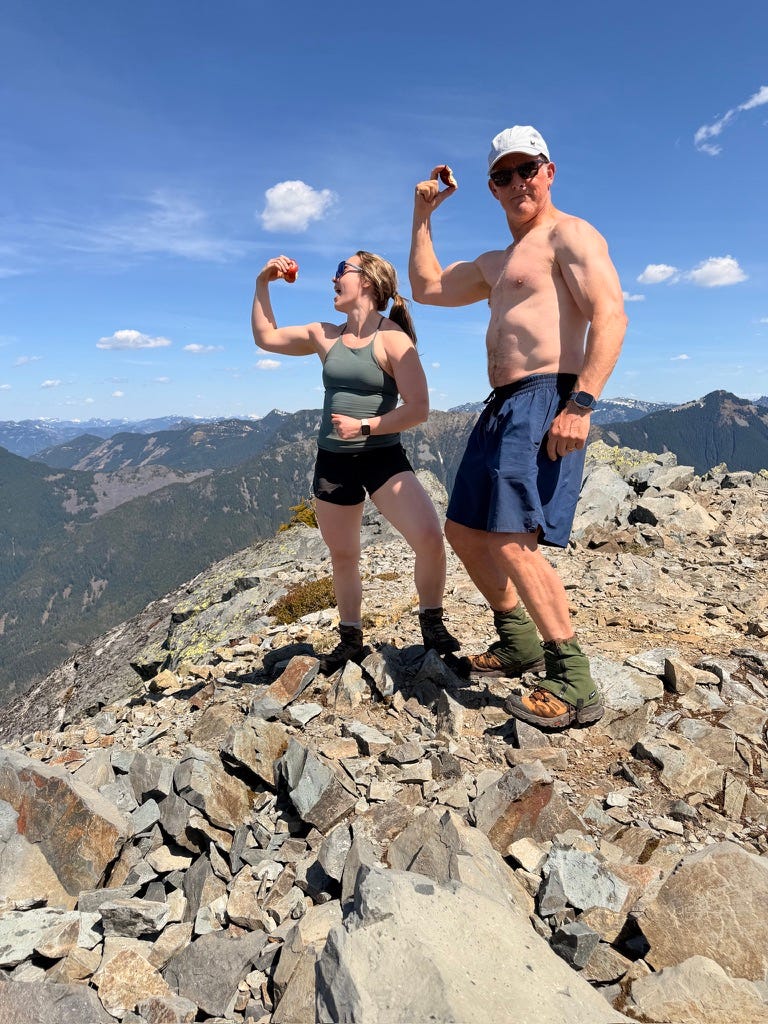
Oh boy!
I don’t admire vanity in others. Sometimes I laugh at it (GB, I’m talking to you); sometimes I actively dislike it. I feel like it’s a character flaw, a weakness. And yet here I was peacocking around with my shirt off. What the fuck?
I’ve had a lot of self-talk around this issue. Hell, I’m having it now! I tell myself that I’ve worked really hard to get lean and build muscle, and it’s okay to wear clothes that show off how I look and, in the right situations, like a sunny day on a mountaintop, to take off my shirt. There’s nothing wrong with it! But I look at this picture I’m sharing with you now and I think, “Really, Tom? It’s come to this?”
I cringe when I see people posturing to gain attention, fishing for compliments. And yet here I was ...
There’s a line here that I’m not sure how to define. I know I’m creeping up on that line and maybe stepping over it, so I’ll try to be careful. (Hell, sharing these pictures with you is a way of both stepping over that line and considering whether it’s okay to feel pride in who I am … I guess I’m straddling that line right now.)
As we came down from the mountain I told the girls about my mixed feelings about my own vanity. Louisa, in this way that she has, set me straight.
“You know Dad, it probably doesn’t occur to you but most of my self talk is around how I don’t look good enough and don’t measure up, and that’s the way most of the girls I know see it. You’re pretty damned lucky to be able to marvel at how good you look without adding in a bunch of negative self-talk.”
Lucky you, struggling with your vanity, she was saying, while I wonder if I’m good enough! And all this coming from a person who is successful in absolutely everything she does (I’ll forgo the details because she wouldn’t want me bragging on her).
We all walk around in our little worlds, thinking the rest of the world thinks like we do, until we find out it’s just not that way.
Anyway, these are the kinds of things I think about while banging around in the woods. That and birds.
Since I’m counting, I’ll just note that this was summit #5 for the year, bringing us to 34,105 vertical feet. 66,000 more to go to seal my membership in Brendan Leonard’s 100k club.
Is it vanity or self love? It’s ok to be proud of your accomplishments including physical ones.
I have absolutely no desire to climb anything but hubby. Hehe.
Congrats on this feat!
Why stop with only your shirt off, Tom?
Just kidding! (talk about crossing the line… but if you wanna show up those younger boys, you go all the way next time, no half measures)
It’s a helpful reminder: the self-talk lives in everyone. Even that retired, ripped guy, with the veins bulging out of his biceps 🫡